'SNL' takes on Iran attacks and Khamenei killing in cold open

The latest "SNL" cold open couldn't be more timely.

USA TODAY

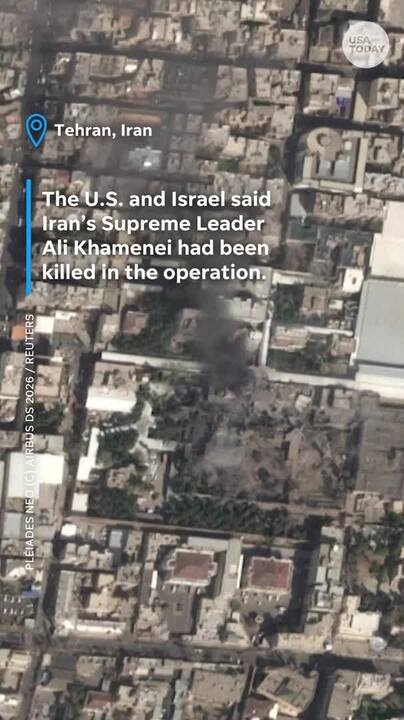
"Saturday Night Live"kicked off its Feb. 28 episode with a sketchaddressing news that the United States and Israel launched military strikes and combat operations against Iranearlier in the day, killing Supreme Leader Ayatollah Ali Khamenei.

In the cold open, James Austin Johnson played PresidentDonald Trumpdelivering remarks and declaring, "Happy World War III to all who celebrate!"

Johnson's Trump went on to say he launched the attack on Iran because he and his "Board of Peace decided that we were bored of peace" and because he needed help "distracting from the Epstein files."

"I know on the campaign trail I promised no new foreign wars," he said. "But listen: Wars, plural, right? I'm allowed to do one."

Surprise!'Heated Rivalry' star Hudson Williams joins Connor Storrie on 'SNL'

James Austin Johnson as President Donald Trump on Dec. 6, 2025.

In a meta moment, Johnson's Trump also implied the breaking news required "SNL" to throw out a cold open focused on the president's State of the Union address earlier in the week.

"People are asking, 'Why attack Iran now?' Well, we had to strike in the early hours of Saturday, which has two advantages militarily: One, it's after the stock market closes for the weekend, and two, it's to cause immeasurable fear, rage and chaos in the 'SNL' writer's room," he said. "Those guys were going crazy. They probably had a big State of the Union address thing they were going to do. Not anymore!"

Advertisement

Colin Jostsoon entered as Defense SecretaryPete Hegsethto declare that although he seems confident, "I am scared and I don't know what I'm doing. When he said we were going to blow up the leader of Iran, I thought he was kidding."

Harry Styles is returning to 'SNL':Get the details

The "SNL" sketch kicked off the show's first new episode after a nearly month-long hiatus. It was also a return to the sketch show's typical format of beginning with a Trump spoof;the cold open of the previous episode on Jan. 31, hosted by Alexander Skarsgård, was rare in that it didn't feature Johnson's portrayal of the president. Instead, former cast member Pete Davidson returned to play White House border czarTom Homan.

Connor Storriehosted the Feb. 28 episode of "SNL," coming off the massive success of "Heated Rivalry." The hockey romance series, streaming on HBO Max, has catapulted Storrie from obscurity to stardom, and the actor made his debut on late-night television in January with a "Late Night With Seth Meyers" interview.

'SNL' cold open:Trump distracts from 'freaks and psychos' in ICE

Mumford & Sons served as musical guest for Storrie's "SNL" episode.

Who's hosting 'SNL' next?

Saturday's episode is the first ofthree consecutive weeks of new "SNL" shows.

Next week's episode will feature thereturn of Ryan Gosling, who is serving as host for the fourth time alongside musical guest Gorillaz. The week after,Harry Styles is doing double dutyas host and musical guest on March 14.

This article originally appeared on USA TODAY:'SNL' cold open addresses Trump's Iran attacks, Khamenei killing

'SNL' takes on Iran attacks and Khamenei killing in cold open

The latest "SNL" cold open couldn't be more timely. "Saturday Night Live"kicked off it...
How the World Is Reacting to the Attack on Iran

A young Iranian protester shouts anti-U.S. and anti-Israeli slogans during an anti-war protest against the U.S. and Israeli military attacks, in Tehran, on Feb. 28, 2026. Credit - Morteza Nikoubazl—NurPhoto via Getty Images

Time

World leaders reacted with a mix of support, condemnation and urgent calls for restraint after the United States and Israel launched a sweeping military campaign against Iran on Saturday thatkilledSupreme Leader Ayatollah Ali Khamenei.

President Donald Trump announced Khamenei's death in a post on Truth Social, calling it "the single greatest chance for the Iranian people to take back their country."

The U.S. and Israel announced their strikes on the Middle Eastern nation in the early hours of Saturday morning after weeks of Trump threatening Iran over their nuclear deal program. The strikes hit the capital Tehran, as well as Qom, Karaj, Kermanshah, Tabriz and Isfahan, where there is a major nuclear facility.

Read More:Does Trump Have the Legal Authority to Strike Iran? An Expert Explains

In the hours after the initial U.S. and Israeli strikes, Russia and China released statements in support of Iran, while Canada, Australia and Ukraine were among those who expressed support for the U.S. and Israel. Several world leaders urged restraint and de-escalation on both sides moving forward.

Here is a round up of what world leaders have said about the operation that has begun war in the Middle East.

United Kingdom

Prime Minister Keir Starmer chaired a meeting of the government's emergency Cobra committee as the country weighs its response to the attacks and Tehran's retaliation across the Gulf.

It did not participate in the military action, but the country had deployed RAF Typhoons to Qatar to protect the al-Udeid airbase and allied bases across the region.

The UK government on Saturday said in a statement it "does not want to see further escalation into a wider regional conflict." Still, a government spokesperson emphasized that "Iran must never be allowed to develop a nuclear weapon and that is why we have continually supported efforts to reach a negotiated solution."

Starmer released a joint statement with French President Emmanuel Macron and  German Chancellor Friedrich Merz, telling Iran to stop their retaliatory attacks on countries in the Middle East.

"We condemn Iranian attacks on countries in the region in the strongest terms," the joint statement reads. "We call for a resumption of negotiations and urge the Iranian leadership to seek a negotiated solution. Ultimately, the Iranian people must be allowed to determine their future."

Russia

Russia condemned the U.S. and Israel's attack, calling it  "a pre-planned and unprovoked act of armed aggression against a sovereign and independent U.N. member state," in a statement from Russia's Foreign Affairs Ministryposted to Telegram.

It accused the U.S. and Israel of  "plunging the Middle East into an abyss of uncontrolled escalation" and said the attacks could cause a "humanitarian, economic and possibly radiological catastrophe" in the Middle East.

China

China's Foreign Ministry spokespersonsaid on Xthat "Iran's sovereignty, security and territorial integrity should be respected."

"China calls for an immediate stop of the military actions, no further escalation of the tense situation, resumption of dialogue and negotiation, and efforts to uphold peace and stability in the Middle East," the statement continued.

France

In addition to the joint statement with the leaders of the United Kingdom and Germany, French President Emmanuel Macronsaid on X, in a post originally in French, that the escalation "is dangerous for all."

"It must stop," he added. "The Iranian regime must understand that it now has no other option but to engage in good faith in negotiations to end its nuclear and ballistic programs, as well as its regional destabilization activities. This is absolutely necessary for the security of all in the Middle East."

He called for an "urgent" meeting of the United Nations Security Council.

European Union

Ursula von der Leyen, the European Union's chief executive, saidin a statement on social mediathat the EU has "consistently promoted diplomatic efforts aimed at addressing the nuclear and ballistic programmes through a negotiated solution.""We call on all parties to exercise maximum restraint, to protect civilians, and to fully respect international law," she said.

Canada

Prime Minister Mark Carney saidin a statement on Xthat Canada supports the U.S. "acting to prevent Iran from obtaining a nuclear weapon and to prevent its regime from further threatening international peace and security."

"Canada's position remains clear: The Islamic Republic of Iran is the principal source of instability and terror throughout the Middle East, has one of the world's worst human rights records and must never be allowed to obtain or develop nuclear weapons."

Australia

Australia's Prime Minister, Anthony Albanese, said in a statement on X that the country backs the U.S. in their military operation.

"We support the United States acting to prevent Iran from obtaining a nuclear weapon and to prevent Iran continuing to threaten international peace and security," he said.

The country also updated their travel recommendations to "Do Not Travel" for Lebanon and Israel.

Pakistan

Pakistan's Ministry of Foreign Affairs released astatementSaturday condemning what it calls "unwarranted attacks against the Islamic Republic of Iran," as well as retaliatory attacks by "Iran against the brotherly countries of Saudi Arabia, Bahrain, Jordan, Kuwait, Qatar and the UAE."

Advertisement

The Ministry confirmed that a Pakistani national was killed in the UAE during the attacks.

"We urge all sides to refrain from any further actions that may undermine the security and territorial integrity of other regional countries," the statement read.

India

India's Ministry of Foreign affairssaid in a statementthat the country is "deeply concerned at the recent developments in Iran and the Gulf region."

"We urge all sides to exercise restraint, avoid escalation, and prioritise the safety of civilians," it continues. "Dialogue and diplomacy should be pursued to de-escalate tensions and address underlying issues. Sovereignty and territorial integrity of all states must be respected."

Spain

Spain Prime Minister Pedro Sánchezcalled on Xfor " immediate de-escalation and full respect for international law," decrying the potential for another "prolonged" war in the Middle East.

"We reject the unilateral military action by the United States and Israel, which represents an escalation and contributes to a more uncertain and hostile international order," he said. "We likewise reject the actions of the Iranian regime and the Revolutionary Guard."

Saudi Arabia

The Saudi Foreign Affairs Ministry condemned Iran's retaliatory strikes across the region in a statement.

"The Kingdom of Saudi Arabia condemns and denounces in strongest terms the blatant Iranian aggression and the flagrant violation of the sovereignty of the U.A.E., Bahrain, Qatar, Kuwait, and Jordan,"  the statement reads.

United Arab Emirates

After the UAE was hit by retaliatory strikes from Iran, its Ministry of Foreign Affairscondemnedits neighbor in a statement, calling the strikes a  "flagrant violation of national sovereignty and a clear breach of international law and the Charter of the United Nations."

"The UAE underscored that it retains its full and legitimate right to respond to these attacks in a manner that safeguards its sovereignty, national security, and territorial integrity, and ensures the safety of its citizens and residents, in accordance with international law," the statement continued.

Oman

Oman's Foreign Minister Badr Al Busaidisaid on XSaturday after the attacks that he was "dismayed."

"Active and serious negotiations have yet again been undermined," said Al Busaidi, who has been a key mediator in recent U.S.-Iran nuclear talks. "Neither the interests of the United States nor the cause of global peace are well served by this. And I pray for the innocents who will suffer."

United Nations

Volker Türk, the UN's Human Rights Commissioner, criticized both the strikes against Iran, and Iran's retaliatory strikes."As always, in any armed conflict, it is civilians who end up paying the ultimate price," he said in a statement on Saturday. "I call for restraint and implore all parties to see reason, to de-escalate, and for a return to the 'negotiating table' where they had been actively seeking a solution only hours earlier."

United Nations Secretary-General António Guterres also condemned military action on all sides of the conflict.

"I call for an immediate cessation of hostilities & de-escalation. Failing to do so risks a wider regional conflict with grave consequences for civilians & regional stability," Guterressaid on X

He also pointed out in the post that the UN's Charter prohibits "the threat of the use of force against the territorial integrity or political independence of any state, or in any other manner inconsistent with the Purposes of the United Nations."

Ukraine

Ukrainian President Volodymyr Zelensky condemned Iran for being "Putin's accomplice" in a poston X reactingto the escalation.

"It is important that the United States is acting decisively. Whenever there is American resolve, global criminals weaken. This understanding must also come to the Russians."

Albania

Albania Prime Minister Edi Ramasaid on Xthat Albania stands "firm with Israel and with the peace-seeking brotherly Arab countries" and that it supports the United States' military contribution.

"We fully endorse every decisive effort to prevent once and for all the murderers in Tehran from acquiring nuclear or any other military capacity to harm Israel or any other peace-loving nation in the Middle East," Rama said. "Terrorism must be named. And once named, it must be stopped."

Hungary

Hungarian Prime Minister Viktor Orbán, a Trump ally in Europe, immediately expressed concerns for how the strikes would impact oil prices. The strikes, he toldreporters, "doubled the importance of the Friendship oil pipeline," which runs through Ukraine. Shipments of Russian oil have been disrupted since January, and Orbán has accused Ukraine ofimposingan "oil blockade."

Kuwait

Kuwait's Ali Al Salem Air Base, which is used by the U.S. military, was also targeted as part of Iran's military retaliation. Kuwait released a statement condemning the Iranian attacks on their soil and asserted their right to respond to the "brazen attack" via Article 51 of the UN Charter.

Qatar

In similar statements to Kuwait and UAE, Qatar condemned Iran's retaliatory attacks and reaffirmed their own right to respond, as per international law.

"The State of Qatar expresses its strong condemnation of the targeting of Qatari territory with Iranian ballistic missiles, considering it a flagrant violation of its national sovereignty, a direct infringement on its security and territorial integrity, and an unacceptable escalation that threatens the security and stability of the region," the statement,posted to X, read.

Lebanon

Lebanese Prime Minister Nawaf Salamsaid on Xthat he "will not accept anyone dragging the country into adventures that threaten its security and unity."

Contact usatletters@time.com.

How the World Is Reacting to the Attack on Iran

A young Iranian protester shouts anti-U.S. and anti-Israeli slogans during an anti-war protest against the U.S. and Israe...
A look at Middle East figures killed by Israel in recent years

BEIRUT (AP) — Israel has killed multiple senior officials with Iran's armed proxies like Hamas in Gaza and Hezbollah in Lebanon since theHamas-led attackon Israel on Oct. 7, 2023.

Associated Press

Now Iran's Supreme LeaderAyatollah Ali Khameneiis dead, following a major attack by Israel and the United States, Iranian state television and the state-run IRNA news agency said Sunday without elaborating on a cause. PresidentDonald Trumppreviously announced the death, saying it gave Iranians their "greatest chance" to "take back" their country.

The compound of the 86-year-old Khamenei was among the first targets in the attack coordinated by the U.S. and Israel. Iran's network of proxies in the region, along with its military assets and regional influence, have been weakened in the past two years, including by last year's 12-day war with Israel.

From Gaza to Lebanon to Iran, Israel has killed leaders withHamas,Hezbollahand theHouthisin Yemen, along withIranian military leaders. Here are some of them:

Ayatollah Ali Khamenei

Khamenei had tried to avert attacks as the U.S. built up its military presence in the region in recent weeks to pressure Tehran over its nuclear program. He allowed Iran to enternegotiations with the U.S., but Saturday's attacks came two days after the latest talks.

Iranian officials on Saturday did not mention his status. Meanwhile, Israel said it killed the commander of Iran's Revolutionary Guard and the defense minister.

Khamenei ascended to power in 1989, taking over from Ayatollah Ruhollah Khomeini, leader of the Islamic Revolution. Aside from the pressure on Iran's nuclear program and armed proxies, Khamenei faced severe economic troubles and discontent that led to nationwide protests weeks ago. He responded with the bloodiest crackdown of his rule.

Saleh Arouri

The deputy political head of Hamas and a founder of the group's military wing,Saleh Arouriwas killed Jan. 2, 2024, in a drone strike in a southern suburb of Beirut. Accused of masterminding attacks against Israel in the West Bank, Arouri was in Israel's sights for years, and Israeli Prime Minister Benjamin Netanyahu threatened to kill him even before Hamas carried out the Oct. 7 attack.

Mohammed Deif

An Israeli airstrike on a compound on the outskirts of Khan Younis in southern Gaza killed the head of Hamas' military wing,Mohammed Deif, on July 13, 2024. More than 90 other people, including displaced civilians in nearby tents, also died. Deif was believed to be one of the masterminds of the Oct. 7 attack and a founder of the Qassam Brigades, Hamas' military wing. He led suicide bombing campaigns against Israeli civilians and built up a formidable arsenal of rockets used to strike into Israel. For years, he topped Israel's most-wanted list.

Advertisement

Fouad Shukur

An Israeli airstrike on a southern suburb of Beirut killed Hezbollah's top military commanderFouad Shukur, on July 30, 2024. The secretive Shukur was in charge of Hezbollah's forces in southern Lebanon and was a top official in its missile program. Shukur, who was a member of Hezbollah's top military body, the Jihadi Council, was accused by the United States of planning and carrying out the truck bombing of a Marine Corps barracks in Beirut that killed 241 American service members. He was the first high-ranking Hezbollah leader to be killed.

Ismail Haniyeh

On July 31, 2024, just hours after the strike that killed Shukur, Hamas' top political leader,Ismail Haniyeh, was killed in a predawn strike in the Iranian capital of Tehran. Israel had pledged to kill the 62-year-old Haniyeh and other Hamas leaders over the Oct. 7 attack. The strike came just after Haniyeh attended the inauguration of Iran's new president.

Hassan Nasrallah

Israeli airstrikes on Beirut's southern suburbs killed Hezbollah's longtime leader and one of its founders,Hassan Nasrallah, on Sept. 27, 2024. An astute strategist, the 64-year-old Nasrallah reshaped Hezbollah into an archenemy of Israel, cementing alliances with Shiite religious leaders in Iran and Palestinian militant groups such as Hamas. Under his leadership, Hezbollah fought wars against Israel and sided with President Bashar Assad during the conflict in neighboring Syria.

Nabil Kaouk

The deputy head of Hezbollah's Central Council,Nabil Kaouk, was killed in an Israeli airstrike south of Beirut a day after Nasrallah. He joined the militant group in its early days in the 1980s. Kaouk also served as Hezbollah's military commander in south Lebanon from 1995 until 2010. He made several media appearances and gave speeches to supporters, including at funerals for Hezbollah militants. He was seen as a potential successor to Nasrallah.

Hashem Safieddine

Israeli airstrikes on a Beirut suburb killed Hezbollah's new leader,Hashem Safieddine, on Oct. 3, 2024, days after he replaced his predecessor, Hassan Nasrallah. A familiar face in Lebanon and a leader with close ties to Iran, he was a member of the group's decision-making Shura Council and its Jihad Council, which acts as its military command. He also headed its Executive Council, which runs schools and social programs. Safieddine was a maternal cousin of Nasrallah.

Yahya Sinwar

Yahya Sinwar, Hamas' leader in the Gaza Strip, who masterminded the Oct. 7 attack on Israel, was killed by Israeli troops on Oct. 16, 2024. Israel had vowed to kill Sinwar since the attack on southern Israel that triggered the ongoing war, but his death finally came about in a chance encounter. Israeli soldiers killed him inside a building in the southern city of Rafah in the Gaza Strip, not knowing his identity until after his body was found.

Mohammad Sinwar

Mohammed Sinwar, believed to be the head of Hamas' armed wing, was killed by an Israeli strike on May 13, 2025, in the Gaza Strip. He was the younger brother of Yahya Sinwar.

Hossein Salami

A wave of Israeli strikes on different parts of Iran killed several top officials with Iran's military and the main paramilitary force on June 13, 2025. Among the high-level military officials killed wasGen. Hossein Salami, the head of Iran's Revolutionary Guard.

Ahmed Al-Rahawi

The prime minister of the Houthi rebel-controlled government,Ahmed al-Rahawi, died in Israeli airstrikes on Yemen's capital of Sanaa on Aug. 28, 2025. He was the most senior Houthi official to be killed since an Israeli-U.S. campaign against the militant group started earlier this year.

Abu Obeida

Israel said one of its airstrikes in Gaza on Aug. 30, 2025, killed the longtime spokesperson for Hamas' armed wing, whom it identified as Hudahaifa Kahlout. Israel had said that Kahlout, who was better known by his nom de guerre,Abu Obeida, was behind the release of videos showing hostages as well as footage of the Hamas-led attack that sparked the war.

A look at Middle East figures killed by Israel in recent years

BEIRUT (AP) — Israel has killed multiple senior officials with Iran's armed proxies like Hamas in Gaza and Hezbollah ...
Dennis Quaid's ex-costar blasts his 'crazy' Trump support after Air Force One trip: 'At least I got to slap him'

Lauren Holly slammed her former costar Dennis Quaid for aligning himself with Republican politicians.

Entertainment Weekly Donald Trump and Dennis Quaid in Corpus Christi, Texas, on Feb. 27, 2026Credit: Eddie Seal/Bloomberg via Getty

Key points

  • "It's crazy to me at this point," she said of Quaid's support for Donald Trump after he flew on Air Force One with the president.

  • "At least I got to slap him real hard in Any Given Sunday," she added under a photo of Quaid with Ted Cruz.

Lauren Hollyisn't pleased withDennis Quaid.

TheNCISactress slammed theReaganactor's alignment with Republican politicians in a series of Threads posts on Friday.

After Sen. Ted Cruzshared a photo of himselfwith Quaid aboard Air Force One on social media on Friday, journalist Yashar Ali shared the same photo on Threads, prompting Holly to offer her two cents in the replies.

"At least I got to slap him real hard inAny Given Sunday,"wrotethe actress, who had a strained onscreen marriage with Quaid in the 1999 football drama.

Lauren Holly and Dennis Quaid in 1999's 'Any Given Sunday'Credit: Warner Brothers/courtesy Everett Collection

Holly also responded to avideo of Quaidsaying "I love Donald Trump" during a public appearance with the president in Corpus Christi, Tex., on Friday.

"It's crazy to me at this point," Hollywrote.

The actress also endorsed and replied to a post labeling Quaid a fascist. "Watching @laurenholly comment on all the Dennis Quiad capitulation is top tier @threads energy. Make fascists uncomfortable by any means possible…" a user wrote.

"Any means…." Hollyresponded.

Lauren Holly in Toronto in 2019Credit: Emma McIntyre/Getty

Representatives for Quaid did not immediately respond toEntertainment Weekly's request for comment.

Advertisement

Prior to the Corpus Christi event, Cruzshared a videoof Quaid seated at a table with Trump on Air Force One.

"I'd like to ask President Reagan what you think of President Trump," the Texas senator says in the clip.

Quaid, who portrayed Ronald Reagan in the 2024 biopicReagan, slipped into character as the 40th U.S. president. "I think he's like me on steroids, actually," he said of Trump in his Reagan voice.

"An historic conversation on AF1 between TWO great American Presidents…." Cruz wrote in his caption.

Quaid previously said heplanned to vote for Trumpin the 2024 election. "As president, the only thing I liked about Trump was everything he did," theRookiestar said onPiers Morgan Uncensored. "People might call him an a--hole, but he's my a--hole."

Dennis Quaid and Donald Trump aboard Air Force One on Feb. 27, 2026Credit: Ted Cruz/X

Get your daily dose of entertainment news, celebrity updates, and what to watch with ourEW Dispatch newsletter.

Quaid recentlydescribed Trumpas "very surprisingly approachable," "very funny," and "really genuine" during an interview with Greg Laurie onThe Greg Laurie Show.

"He wouldn't be president if he wasn't genuine," the actor said. "Because people, the people who voted for him, they know that he has their best interests at heart, that he is a genuine person."

Read the original article onEntertainment Weekly

Dennis Quaid's ex-costar blasts his 'crazy' Trump support after Air Force One trip: 'At least I got to slap him'

Lauren Holly slammed her former costar Dennis Quaid for aligning himself with Republican politicians. Key point...
Rod Stewart, 81, Performs 'Forever Young' with Daughter Ruby and 2-Year-Old Grandson Otis: 'Three Generations of Stewarts'

Rod Stewart was joined onstage by his daughter Ruby Stewart and grandson Otis during his Feb. 27 show in Florida

People Rod Stewart with daughter Ruby and grandson Otis on Feb. 27, 2026Credit: Sandy / BACKGRID

NEED TO KNOW

  • Ruby, a singer herself, performed "Forever Young" with her dad while her son Otis, 2, held her close

  • Ruby is one of Rod's eight children

Rod Stewart's latest show was a bit of a family affair.

As the British singer-songwriter, 81, was performing at Hard Rock Live in Hollywood, Fla., on Friday, Feb. 27, as part of his ongoingOne Last Time Farewell Tour, his daughterRuby Stewartjoined him onstage with yet another special guest: her 2-year-old son,Otis.

Rod's 38-year-old daughter and her little one joined the rocker for a performance of "Forever Young," with Ruby — a musician herself — performing a duet to the '80s track with her father.

Rod Stewart with daughter Ruby Stewart and grandson Otis on Feb. 27, 2026Credit: Sandy / BACKGRID

Rod and Ruby sang for the Florida crowd as Otis, who sported a pair of noise-canceling headphones, clung to his mother's leg in a clip of the family performance that Ruby shared in anInstagram Storiespost on Saturday, Feb. 28.

Then, Ruby scooped up her son and, during an instrumental break in the song, danced with her father while holding the toddler in her arms. Rod could not seem to stop smiling as he looked on at the mother-son duo.

"Three generations of [Stewarts] one stage…," Ruby captioned the post.

Rod Stewart with daughter Ruby and grandson Otis on Feb. 27, 2026Credit: ruby Stewart/Instagram

Rod shares Ruby, one of his eight children, with ex-girlfriendKelly Emberg. The self-described "songstress" inherited the music genes from her dad and pursued a career as a singer. She was previously part of country music duo The Sisterhood, which disbanded in 2021, and is currently a solo artist who — like the Friday show — occasionally joins her dad for a performance.

Ruby shares Otis with fiancé Jake Kalic. The coupleannounced their engagementin early 2023 and revealed on social media that they had welcomed their son later that year, on Mother's Day.

"This love… unlike any other love I've ever known," Ruby said of Otis on Instagram at the time. She also shared that the now-toddler was born on May 9 at 3:36 p.m. and weighed in at 8 lbs., 8 oz.

Advertisement

Rod Stewart with daughter Ruby and grandson Otis on Feb. 27, 2026Credit: ruby Stewart/Instagram

Ruby has shared occasional glimpses into the family of three's life on Instagram, including marking Otis turning 2 with a special birthday-Mother's Day hybridpostlast year.

"You are two," the proud mom wrote alongside a sweet outdoor photo of the toddler. She went on to list "some of my favorite moments from this last year."

The moments ranged from "hearing you say I love you for the first time" and "seeing you muster up the courage to do things that scare you" to "seeing you hug your friends at school who are crying."

"And in all these moments.. I find myself having current nostalgia… I already miss the day you used to fit in my arms… the days we'd walk holding hands… the mornings I'd wake to you sleeping peacefully between us…," Ruby wrote of the 2-year-old. "One day you will outgrow me… but you will always be my baby… Happy birthday sweet Otis."

Ruby Stewart with fiancé Jake Kalic and son OtisCredit: ruby stewart/Instagram

Rod's wife,Penny Lancaster, commented on the post, writing, "Best Mothers Day to you and happy 2nd birthday, beautiful Otis (as of two days ago) xx."

Never miss a story — sign up forPEOPLE's free daily newsletterto stay up-to-date on the best of what PEOPLE has to offer​​, from celebrity news to compelling human interest stories.

In addition to Ruby, the rock legendhas seven other sons and daughters. He shares the eight children with five mothers.

In total, the "Maggie May" crooner is a father to four daughters — Sarah, 62, Kimberly, 46, Ruby, 38, and Renee, 33 — and four sons — Sean, 45, Liam, 31, Alastair Wallace, 20, and Aiden Patrick, 15.

Read the original article onPeople

Rod Stewart, 81, Performs 'Forever Young' with Daughter Ruby and 2-Year-Old Grandson Otis: 'Three Generations of Stewarts'

Rod Stewart was joined onstage by his daughter Ruby Stewart and grandson Otis during his Feb. 27 show in Florida ...
Michael Jackson's Estate Sued for Child Trafficking by 4 Siblings Who Claim the Late Pop Star Abused Them

Four adult siblings are suing the estate of Michael Jackson for child sex trafficking, claiming that the late musician abused them when they were minors

People Michael Jackson in 2005Credit: Carlo Allegri/Getty

NEED TO KNOW

  • Edward, Dominic, Marie-Nicole and Aldo Cascio alleged that Jackson "groomed and brainwashed" them and transported them around the world

  • A lawyer for Jackson's estate criticized the filing, calling it a "transparent forum-shopping tactic in their scheme to obtain hundreds of millions of dollars from Michael's estate and companies"

Four adult siblings are suing the estate ofMichael Jacksonfor child sex trafficking, claiming that the late musician abused them when they were minors.

In a complaint filed on Friday, Feb. 27, and obtained by PEOPLE, siblings Edward, Dominic, Marie-Nicole and Aldo Cascio alleged that Jackson — who died in 2009 at age 50 — "groomed and brainwashed" them using his wealth, celebrity status and network of employees and advisers.

The suit states that Jackson met the Cascio siblings through their father, who worked at a luxury hotel Jackson visited multiple times. The siblings allege that after he gained the family's trust by offering them gifts, affection and attention, the musician allegedly isolated them from many adults, gave them drugs and alcohol, exposed them to pornography and individually abused them.

"Michael Jackson was a serial child predator who, over the course of more than a decade, drugged, raped and sexually assaulted each of the plaintiffs, beginning when some were as young as seven or eight," the 23-page suit states. "The filing alleges that the abuse occurred over extended periods in multiple locations worldwide, including during visits when Jackson and his children stayed at the siblings' family home."

Michael Jackson in 1996Credit: Phil Dent/Redferns

In a statement provided to PEOPLE, attorney Marty Singer, who represents the Jackson estate, called the lawsuit "a desperate money grab by additional members of the Cascio family who have hopped on the bandwagon with their brother Frank, who is already being sued in arbitration for civil extortion."

"The family staunchly defended Michael Jackson for more than 25 years, attesting to his innocence of inappropriate conduct. This new court filing is a transparent forum-shopping tactic in their scheme to obtain hundreds of millions of dollars from Michael's estate and companies," Singer said in part.

"Statements by the Cascios, including those appearing in dozens of passages throughout Frank Cascio's 2011 book, as well as in interviews with Oprah Winfrey and others, directly contradict what is being alleged now," Singer continued. "Throughout, the Cascios consistently and repeatedly asserted that Michael never harmed any of them or anyone else. With the Estate's financial success growing, the Cascios, through two different attorneys, threatened to go public with heinous accusations that completely contradicted their previous statements defending Michael unless his Estate paid staggering sums of money."

The complaint was filed one month after the four Cascio siblings appeared in a Beverly Hills, Calif., courthouse for a related financial settlement with Jackson's estate that they described as "an unlawful agreement to silence victims of childhood sexual abuse." A follow-up hearing is set for Thursday, March 5.

In an interview published by theDaily Mailon Saturday, Feb. 28, Aldo Cascio, now 35 — along with parents Dominic and Connie and sister Marie-Nicole — opened up about the alleged sexual abuse, which Aldo said began when he was 7 years old.

"I was just sitting on the bed with him during the day, and I was just playing my Game Boy," Aldo said. "And I remember he just went to me and pulled down my shorts."

"It didn't stun me or anything. I remember being like, just keep playing my Game Boy, and he took down my shorts and started performing oral sex and I was still... I didn't ask him anything," he continued, sharing that Jackson told him afterwards that the act was how he expressed love. "This was Michael. I know Michael, I know he loves me, and I love him."

Michael Jackson at the 2003 Radio Music Awards.Credit: M. Caulfield/WireImage

The family recounted how they met Jackson in 1984, when Dominic was working as manager of the Helmsley Palace in New York, where the musician often stayed. They eventually grew close, and Dominic introduced Jackson to his wife and children.

"Michael said, 'I want to surprise the kids,' " Dominic recalled. "He arrived at their house, and Connie says he wanted to see the kids' rooms... He told jokes to the kids... he was so kind. We didn't think about it."

Advertisement

"He would train me to say no to any authority and the police," Aldo alleged of Jackson. "If anyone asked, 'Are you doing this?' you would say no. He would say that people think this is wrong, but they're wrong. This is real, this is love, but these people think it's wrong and I could get into trouble — they'll want to kill me... he would make me 'Promise you love me and that you'll protect me'... And so you felt responsible for helping him in any way."

Aldo also alleged that Jackson took Xanax in front of him and gave him some.

"He was a big drinker, and so the real him was this creepy monster that you felt responsible for," he claimed.

Marie-Nicole also told the outlet that Jackson stayed with the family for four months following the 9/11 attacks in 2001 — and then he began abusing her, too.

"He talked about how it's very normal for men and women to be naked," she claimed. "He asked me to take off my clothes. So, I did what he said."

Want to keep up with the latest crime coverage? Sign up forPEOPLE's free True Crime newsletterfor breaking crime news, ongoing trial coverage and details of intriguing unsolved cases.

In the complaint, Edward alleged that he was sexually assaulted by Jackson during interstate and international travel, including stops on the singer's Dangerous World Tour and visits to Elizabeth Taylor's Switzerland home and Elton John's U.K. residence, as well as Jackson's Neverland Ranch in California.

Dominic claimed he was abused by Jackson in Florida, New Jersey, New York, France and South Africa — including during the pop star's HIStory World Tour — at Neverland Ranch and at the Cascio family's New Jersey home. Aldo alleged he was assaulted during international travel, at Neverland Ranch, in New York, at the family's home and more, while Marie-Nicole claimed she was also assaulted at Neverland Ranch, at their home, in New York, Las Vegas and Florida. The filing also alleges that Jackson attempted to assault Marie-Nicole in Bahrain.

"Since middle school, it introduced me to hell and my demons," Aldo said of the alleged abuse. "I realized that I might want to end my life one day."

When he learned about Jackson's death in 2009 — only three days after he last spoke to the late music star — Aldo said he felt "relief."

"I also had to act sad. I knew that I had to play this double role," he remembered. "Why did he do this to me? I hated him and knew I couldn't free myself of it. I had to live my whole life alone with this, and it was hell."

If you or someone you know has been a victim of sexual abuse, text "STRENGTH" to the Crisis Text Line at 741-741 to be connected to a certified crisis counselor.

If you suspect child abuse, call the Childhelp National Child Abuse Hotline at 1-800-4-A-Child or 1-800-422-4453, or go towww.childhelp.org. All calls are toll-free and confidential. The hotline is available 24/7 in more than 170 languages.

Read the original article onPeople

Michael Jackson's Estate Sued for Child Trafficking by 4 Siblings Who Claim the Late Pop Star Abused Them

Four adult siblings are suing the estate of Michael Jackson for child sex trafficking, claiming that the late musician ab...
Iran's Supreme Leader Ayatollah Ali Khamenei, who led the Islamic Republic since 1989, is dead at 86

DUBAI, United Arab Emirates (AP) — AyatollahAli Khamenei, who assembled theocratic power in Iran over the decades as its supreme leader and sought to turn it into a regional powerhouse, bringing it into confrontation with Israel and the United Statesover its nuclear programwhile crushing democracy protesters at home, has died. He was 86.

Associated Press FILE - In this photo released by the official website of the office of the Iranian supreme leader, Supreme Leader Ayatollah Ali Khamenei speaks under a portrait of the late revolutionary founder Ayatollah Khomeini, in a ceremony meeting a group of officials, in Tehran, Iran, March 8, 2025. (Office of the Iranian Supreme Leader via AP, File) FILE - Iran's supreme leader Ayatollah Ali Khamenei, center, leaves an event titled FILE — In this photo released by an official website of the office of the Iranian supreme leader, Supreme Leader Ayatollah Ali Khamenei attends a meeting commemorating Prophet Muhammad's birthday anniversary in Tehran, Iran, Sept. 21, 2024. (Office of the Iranian Supreme Leader via AP, File) FILE- In this picture released by the official website of the office of the Iranian supreme leader, Supreme Leader Ayatollah Ali Khamenei listens to the then commander of the Revolutionary Guard Mohammad Ali Jafari during a graduation ceremony of a group of the guard's officers in Tehran, Iran, May 20, 2015. (Office of the Iranian Supreme Leader via AP, File) FILE — Iran's supreme leader Ayatollah Ali Khamenei waves as he attends the 18th anniversary of the death of Iran's late leader Ayatollah Ruhollah Khomeini, the founder of the Islamic revolution in Tehran, June 4, 2007. (AP Photo/Hasan Sarbakhshian, File)

Iran Obit Ayatollah Ali Khamenei

Iranian state media reported the death early Sunday, aftera major attacklaunched by Israel and the United States. U.S. President Donald Trump said hours earlier that Khamenei had been killed in the joint operation.

Khamenei dramatically remolded the Islamic Republic since he took the reins after the death of AyatollahRuhollah Khomeiniin 1989. Khomeini was the fiery, charismatic ideologue who led the overthrow of the shah and installed rule by Shiite Muslim clerics tasked with spreading religious purity. It fell to Khamenei, a stodgier figure with weaker religious credentials and a leaden demeanor, to turn that revolutionary vision into a state establishment.

He ended up ruling far longer than Khomeini. He greatly expanded the Shiite clerical class and built theparamilitary Revolutionary Guardinto the most important body underpinning his rule. The Guard became a military and business behemoth, the country's most elite force and head of its ballistic missile arsenal, with hands across Iran's economic sectors.

But the strains became harder to contain. Political repression andthe faltering economyfueled successively bigger waves of mass protests. Anger over the2022 death of Mahsa Amini, detained for not wearing her mandatory headscarf properly, escalated into demonstrations against social restrictions. In early January, hundreds of thousands marched in cities across the country, many chanting, "Death to Khamenei."

Khamenei responded with the deadliest crackdown seen in nearly 50 years of clerical rule as security forces opened fire on crowds, killing thousands.

At the same time, the Mideast wars sparked byHamas' Oct. 7, 2023, attack on Israelset in motion the collapse of the regionwide "Axis of Resistance" built by Khamenei. Israel and Iran attacked each other directly for the first time in 2024. Israel struck Iran again in June 2025, as it and the United Statestargeted the country's nuclear programand killed top military officers and nuclear scientists. Iran retaliated by sending missiles and drones at Israel.

Khamenei's death raises questions about the future of the Islamic Republic.

The 88-seat Assembly of Experts, a group of mostly hard-line clerics, will choose Khamenei's replacement. But no clear successor is in place.

Advertisement

As helaunched the bombingin February, U.S. President Donald Trump called on Iranians to"take over your government. It will be yours to take.This will be probably your only chance for generations." What happens next may depend greatly on bodies like the Revolutionary Guard, which has repeatedly shown its willingness to use overwhelming force to keep power even as many of Iran's90 million people grow disenchanted.

"Culturally, the government is bankrupt," said Mehdi Khalaji, an analyst at the Washington Institute for Near East Policy, said in 2017. "The ideology of the Islamic Republic did not work at all."

From a questioned start to a hard-line grip on Iran

Ali Khamenei was born into a religious family in the northeastern holy city of Mashhad, a hotbed of revolutionary fervor during the struggle against the Western-allied shah,Mohammad Reza Pahlavi.

Like many other Iranian leaders, he studied under Khomeini at the seminary in the holy city of Qom, south of Tehran, in the early 1960s, before the Khomeini's exile to Iraq and France.

Khamenei joined the anti-shah movement, facing time in both prison and in hiding. WhenKhomeini returned to Iran in triumph in February 1979and proclaimed the Islamic Republic, Khamenei was appointed to the secretive Revolutionary Council. In 1981, he was elected Iran's third president; that same year, a bombing by opponents left him with one hand paralyzed.

With his thick, heavy-framed glasses, Khamenei lacked the steely gaze and fiery aura of Khomeini, the father of the Islamic Revolution. He fell far short of Khomeini's religious scholarship, holding the relatively low rank of "hojatolislam" in the Shiite clerical hierarchy.

After being named supreme leader after Khomeini's death, he bounded overnight to the level of grand ayatollah, at the top of the hierarchy, and for years had to deal with skepticism over his credentials.

Khamenei acknowledged the doubts with humility. "I am an individual with many faults and shortcomings and truly a minor seminarian," he said in his first speech in his new post.

Despite his lack of charisma, Khamenei stabilized Iran afterthe 1980s war with Iraqand governed for over three decades — far longer than Khomeini.

Hard-liners considered him second only to God in his authority. Khamenei created an ever-growing bureaucracy of Shiite clerics and governmental agencies that blurred responsibilities and left him as the ultimate arbiter. As Iran questioned whether to keep the Revolutionary Guard after the war with Iraq, Khamenei came to its rescue and allowed the paramilitary force to gain a powerful grip on Iran's economy. He also used a system of appointees to undercut the civilian government elected by its people.

The rise and fall of Iran's proxy forces

Under Khamenei's reign, Iran shifted fully from conventional warfare to support for proxies, building the so-called Axis of Resistance to advance its interests in the region. TheLebanese militant group Hezbollah, established with Iran's help in the 1980s, drove Israel from southern Lebanon in 2000 and battled it to a stalemate in the monthlong 2006 war.Through Hezbollah, Iran perfected a strategy of making local militant groups its allies to project power — often through violence. Iran followed that model when backingYemen's Houthi rebels, who in 2014 seized the country's capital, Sanaa, and held on for over a decade in a stalemated war in the Arab world's poorest nation — despite facing a Saudi-led coalition and later,U.S.-led airstrikes over their attacks in the Red Seacorridor.Elsewhere, suspected Iranian-backed militants bombed aJewish center in Buenos Aires in 1994, killing 85 people. Iran also was allegedly linked to the 1996 bombing of the Khobar Towers housing complex in Saudi Arabia, which killed 19 members of the U.S. military. Iran denied responsibility for both attacks.Iran emerged as a prime beneficiary of theU.S.-led invasion of Iraq in 2003, which replaced its main regional threat, Saddam Hussein, with a friendly Shiite-led government. Iranian-backed militias waged a brutal insurgency against U.S. forces and embedded themselves within the country's political landscape.Khamenei used the Guard's expeditionary Quds Force most successfully after the Sunni extremists of theIslamic State group seized large swathsof Iraq and Syria in 2014. Guard troops advised Shiite militias, the best fighters in Iraq, and gave crucial support toPresident Assad in Syria's civil war.That secured Assad for a decade, until the chaos sparked byHamas' attack on Israelin 2023. Israel devastated the Gaza Strip and launched airstrikes and ground operations pulverizing Hamas, which Iran had armed and funded for years. Israel is widely believed to have killedHamas leader Ismail Haniyehin an operation in Tehran in 2024, further embarrassing the Islamic Republic.Hezbollah found its ranks targeted by exploding pagers and anIsraeli campaign killed its longtime leader Hassan Nasrallah. Then, in December 2024,rebel fighters toppled Assadin an offensive in Syria, ending a half-century of his family's autocratic rule.Nuclear program advances to near-weapons-grade levelsThe supreme leader remained deeply suspicious of the U.S.,referring to it as the "Great Satan"even after President Barack Obama came into office in 2009, offering dialogue and a fresh start.He shrugged off U.N. sanctions andpushed ahead with Iran's nuclear program, which the U.S. and its allies say hid a secret project to build a nuclear weapon up until 2003. Khamenei issued a verbal fatwa, or religious ruling, that nuclear weapons are un-Islamic, but vowed the country would never give up its right to develop what he called a peaceful nuclear energy program.Under Iran's 2015 nuclear deal with world powers, Tehran agreed to drastically reduce its stockpile and enrichment of uranium in exchange for the lifting of economic sanctions. But only three years later, Trump in his first term unilaterally withdrew Washington from the accord, arguing it didn't go far enough.Iran has since broken all the limits of the nuclear deal and accumulated a stockpile of uranium enriched to nearly weapons-grade levels, now large enough to pursue several nuclear weapons if it chose to do so. Diplomatic efforts to restore the deal under President Joe Biden stalled.In a March 2011 speech, Khamenei used toppled Libyan dictator Moammar Gadhafi, who had given up his own nuclear program years earlier, as an example of why Iran's nuclear program remained so importantin the wake of the Arab Springupheavals in the Middle East."Just the way you give a lollipop to a child, Westerners gave 'incentives' to them and they gave up everything," Khamenei said.Protests and demands for change intensifiedKhamenei's first major challenge came in 1997, when pro-reform politicians gained control of parliament and clericMohammad Khatami was elected presidentby a landslide, riding a large youth vote. The reformists demanded a loosening of the strict social rules imposed by the revolution and called for improved ties with the outside world, including the U.S.Khamenei-backed hard-liners moved to contain the liberal movement, fearing it would eventually call for an end to clerical rule. Khamenei stopped parliament from loosening restrictions on the media in an unusually overt intervention. Clerical bodies blocked other key liberal legislation and banned many reformist lawmakers from running for reelection, ensuring a return of hard-liner control in the 2004 elections.That set the stage for the election ofhard-line President Mahmoud Ahmadinejadin 2005 and his disputed reelection in 2009 amid charges of vote-rigging. Massprotests broke out, posing the greatest threatin decades to Iran's clerical leadership. The Revolutionary Guard, Basij militia and police unleashed acrackdown in which dozens were killedand hundreds arrested.The turmoil, and reports of protesters being tortured to death or raped in prison, dealt a severe blow to Khamenei's prestige.As sanctions bit further, popular unrest rose. Economic protests broke out in 2017 and demonstrations escalated in 2019 over a rise in government-set gasoline prices. A bloody crackdown that followed killed over 300 people, according to activists.Although Khamenei struggled to preserve the ideological purity of the Islamic Revolution, Iran's government has largely failed to rid the country of Western influence. Satellite dishes, banned in theory, crowd Tehran's rooftops. Banned social media sites are widely used, even by some prominent politicians, despite being blocked.Protests erupted again in 2022 over the death of Amini, a young woman detained for not wearing her hijab, or headscarf, to the liking of authorities. More than 500 people were killed and tens of thousands arrested when security forces crushed the demonstrations again.In late December 2025, new economic protests erupted and would grow into what appeared to be the biggest protest movement ever. Hundreds of thousands across the country took to the streets, overtly demanding an end to the Islamic Republic. Some even chanted for the return of the shah's son, living in exile since 1979. Theferocity of the crackdownstunned Iranians.Confrontation with USWith U.S. President Donald Trump, Khamenei faced a more aggressive and unpredictable American drive to stop Iran's nuclear program. Trump unilaterallywithdrew America from Iran's nuclear dealwith world powers in 2018, bringing a return of sanctions.The two sides came close to war with the United States after an American drone strike killedRevolutionary Guard Gen. Qassem Soleimaniin January 2020. At Soleimani's mass funeral that drew millions to the streets,Khamenei wept over the casketof the man he once called a "living martyr." Two days later, theGuard mistakenly shot down a Ukrainian airlinerafter its takeoff from Tehran, killing all 176 people aboard.Iran ramped uranium enrichment back up, reaching 60% purity — a short, technical step away from weapons-grade levels of 90%. Still, when Trump returned to the White House in January 2025,Khamenei resumed talks,underscoring the deep toll the sanctions had taken.Iran's long-ailing economyentered a freefall worsening domestic unrest.But a deal remained elusive. In June 2025, Israel and the U.S. bombed Iranian nuclear facilities, inflicting heavy damage, though how far back it set the program remained unclear.During the crackdown on nationwide protests in January, Trump renewed threats to strike, demanding Iran make major concessions at the negotiating table. Then camethree rounds of indirect talks. Then came Saturday.___Former Associated Press writer Brian Murphy contributed.

Under Khamenei's reign, Iran shifted fully from conventional warfare to support for proxies, building the so-called Axis of Resistance to advance its interests in the region. TheLebanese militant group Hezbollah, established with Iran's help in the 1980s, drove Israel from southern Lebanon in 2000 and battled it to a stalemate in the monthlong 2006 war.

Through Hezbollah, Iran perfected a strategy of making local militant groups its allies to project power — often through violence. Iran followed that model when backingYemen's Houthi rebels, who in 2014 seized the country's capital, Sanaa, and held on for over a decade in a stalemated war in the Arab world's poorest nation — despite facing a Saudi-led coalition and later,U.S.-led airstrikes over their attacks in the Red Seacorridor.

Elsewhere, suspected Iranian-backed militants bombed aJewish center in Buenos Aires in 1994, killing 85 people. Iran also was allegedly linked to the 1996 bombing of the Khobar Towers housing complex in Saudi Arabia, which killed 19 members of the U.S. military. Iran denied responsibility for both attacks.

Iran emerged as a prime beneficiary of theU.S.-led invasion of Iraq in 2003, which replaced its main regional threat, Saddam Hussein, with a friendly Shiite-led government. Iranian-backed militias waged a brutal insurgency against U.S. forces and embedded themselves within the country's political landscape.

Khamenei used the Guard's expeditionary Quds Force most successfully after the Sunni extremists of theIslamic State group seized large swathsof Iraq and Syria in 2014. Guard troops advised Shiite militias, the best fighters in Iraq, and gave crucial support toPresident Assad in Syria's civil war.

That secured Assad for a decade, until the chaos sparked byHamas' attack on Israelin 2023. Israel devastated the Gaza Strip and launched airstrikes and ground operations pulverizing Hamas, which Iran had armed and funded for years. Israel is widely believed to have killedHamas leader Ismail Haniyehin an operation in Tehran in 2024, further embarrassing the Islamic Republic.

Hezbollah found its ranks targeted by exploding pagers and anIsraeli campaign killed its longtime leader Hassan Nasrallah. Then, in December 2024,rebel fighters toppled Assadin an offensive in Syria, ending a half-century of his family's autocratic rule.

Nuclear program advances to near-weapons-grade levels

The supreme leader remained deeply suspicious of the U.S.,referring to it as the "Great Satan"even after President Barack Obama came into office in 2009, offering dialogue and a fresh start.

He shrugged off U.N. sanctions andpushed ahead with Iran's nuclear program, which the U.S. and its allies say hid a secret project to build a nuclear weapon up until 2003. Khamenei issued a verbal fatwa, or religious ruling, that nuclear weapons are un-Islamic, but vowed the country would never give up its right to develop what he called a peaceful nuclear energy program.

Under Iran's 2015 nuclear deal with world powers, Tehran agreed to drastically reduce its stockpile and enrichment of uranium in exchange for the lifting of economic sanctions. But only three years later, Trump in his first term unilaterally withdrew Washington from the accord, arguing it didn't go far enough.

Iran has since broken all the limits of the nuclear deal and accumulated a stockpile of uranium enriched to nearly weapons-grade levels, now large enough to pursue several nuclear weapons if it chose to do so. Diplomatic efforts to restore the deal under President Joe Biden stalled.

In a March 2011 speech, Khamenei used toppled Libyan dictator Moammar Gadhafi, who had given up his own nuclear program years earlier, as an example of why Iran's nuclear program remained so importantin the wake of the Arab Springupheavals in the Middle East.

"Just the way you give a lollipop to a child, Westerners gave 'incentives' to them and they gave up everything," Khamenei said.

Protests and demands for change intensified

Khamenei's first major challenge came in 1997, when pro-reform politicians gained control of parliament and clericMohammad Khatami was elected presidentby a landslide, riding a large youth vote. The reformists demanded a loosening of the strict social rules imposed by the revolution and called for improved ties with the outside world, including the U.S.

Khamenei-backed hard-liners moved to contain the liberal movement, fearing it would eventually call for an end to clerical rule. Khamenei stopped parliament from loosening restrictions on the media in an unusually overt intervention. Clerical bodies blocked other key liberal legislation and banned many reformist lawmakers from running for reelection, ensuring a return of hard-liner control in the 2004 elections.

That set the stage for the election ofhard-line President Mahmoud Ahmadinejadin 2005 and his disputed reelection in 2009 amid charges of vote-rigging. Massprotests broke out, posing the greatest threatin decades to Iran's clerical leadership. The Revolutionary Guard, Basij militia and police unleashed acrackdown in which dozens were killedand hundreds arrested.

The turmoil, and reports of protesters being tortured to death or raped in prison, dealt a severe blow to Khamenei's prestige.

As sanctions bit further, popular unrest rose. Economic protests broke out in 2017 and demonstrations escalated in 2019 over a rise in government-set gasoline prices. A bloody crackdown that followed killed over 300 people, according to activists.

Although Khamenei struggled to preserve the ideological purity of the Islamic Revolution, Iran's government has largely failed to rid the country of Western influence. Satellite dishes, banned in theory, crowd Tehran's rooftops. Banned social media sites are widely used, even by some prominent politicians, despite being blocked.

Protests erupted again in 2022 over the death of Amini, a young woman detained for not wearing her hijab, or headscarf, to the liking of authorities. More than 500 people were killed and tens of thousands arrested when security forces crushed the demonstrations again.

In late December 2025, new economic protests erupted and would grow into what appeared to be the biggest protest movement ever. Hundreds of thousands across the country took to the streets, overtly demanding an end to the Islamic Republic. Some even chanted for the return of the shah's son, living in exile since 1979. Theferocity of the crackdownstunned Iranians.

Confrontation with US

With U.S. President Donald Trump, Khamenei faced a more aggressive and unpredictable American drive to stop Iran's nuclear program. Trump unilaterallywithdrew America from Iran's nuclear dealwith world powers in 2018, bringing a return of sanctions.

The two sides came close to war with the United States after an American drone strike killedRevolutionary Guard Gen. Qassem Soleimaniin January 2020. At Soleimani's mass funeral that drew millions to the streets,Khamenei wept over the casketof the man he once called a "living martyr." Two days later, theGuard mistakenly shot down a Ukrainian airlinerafter its takeoff from Tehran, killing all 176 people aboard.

Iran ramped uranium enrichment back up, reaching 60% purity — a short, technical step away from weapons-grade levels of 90%. Still, when Trump returned to the White House in January 2025,Khamenei resumed talks,underscoring the deep toll the sanctions had taken.Iran's long-ailing economyentered a freefall worsening domestic unrest.

But a deal remained elusive. In June 2025, Israel and the U.S. bombed Iranian nuclear facilities, inflicting heavy damage, though how far back it set the program remained unclear.

During the crackdown on nationwide protests in January, Trump renewed threats to strike, demanding Iran make major concessions at the negotiating table. Then camethree rounds of indirect talks. Then came Saturday.

Former Associated Press writer Brian Murphy contributed.

Iran’s Supreme Leader Ayatollah Ali Khamenei, who led the Islamic Republic since 1989, is dead at 86

DUBAI, United Arab Emirates (AP) — AyatollahAli Khamenei, who assembled theocratic power in Iran over the decades as its ...
Russia condemns US-Israel strikes on Iran as 'unprovoked act of armed aggression'

Russia on Saturday condemnedthe U.S.-Israeli strikes on Iranas "a preplanned and unprovoked act of armed aggression against a sovereign and independent U.N. member state," demanding an immediate halt to the military campaign and a return to diplomacy.

Associated Press

In a statement posted to Telegram, the Foreign Ministry accused Washington and Tel Aviv of "hiding behind" concerns about Iran's nuclear program while actually pursuing regime change.

It warned the attacks risked triggering a "humanitarian, economic and possibly radiological catastrophe" in the region and accused the U.S. and Israel of "plunging the Middle East into an abyss of uncontrolled escalation."

Russia has emerged as a keytrade partner and supplier of weaponsand technologies for Iran, which has faced bruising international sanctions. Though Russia's Foreign Ministry was quick to condemn the U.S.-Israeli attacks, the Kremlin will likely carefully assess its response followinga recent warming of tiesbetween Moscow and Washington.

Russian President Vladimir Putin has praised U.S. President Donald Trump's efforts to mediate an end to the conflict in Ukraine, and Moscow and Washington have discussed ways to revive their economic ties.

Russian Foreign Minister Sergey Lavrov spoke by phone with Iranian Foreign Minister Abbas Araghchi, Russia's Foreign Ministry said. Araghchi briefed Lavrov on Iran's attempts to repel the attacks and said Iran would seek to convene an urgent U.N. Security Council session, it said. Lavrov reiterated Russia's condemnation of the U.S.-Israeli strikes and Moscow's readiness to help broker peace.

Kremlin spokesman Dmitry Peskov said Putin discussed the situation in Iran with Russia's Security Council via videoconference, but did not give details.

In the Foreign Ministry statement, Moscow called the bombing of nuclear facilities under International Atomic Energy Agency safeguards "unacceptable" and said it stood ready to help broker a peaceful resolution, while placing full responsibility for the escalation on the United States and Israel.

Advertisement

"Responsibility for the negative consequences of this manmade crisis, including an unpredictable chain reaction and spiraling violence, lies entirely with them," the statement said.

Russia's Foreign Ministry also condemned what it called "the serial nature of destabilizing attacks carried out by the U.S. administration," accusing the U.S. of attacking "the international legal pillars of the world order."

Russia has maintained a delicate balancing act in the Middle East for decades, trying to navigate its warm relations with Israel even as it has developed strong economic and militaryties with Iran.

Iranian forces and Russian sailors conducted annual drills in the Gulf of Oman and the Indian Ocean last week aimed at "upgrading operational coordination as well as exchange of military experiences," Iran's state-run IRNA news agency reported.

Putin and his Iranian counterpart, Masoud Pezeshkian, signed a broad cooperation pact in January last year as their countries deepened their partnership in the face of stinging Western sanctions.

The West alleges that in 2022,Russia and Iransigned a $1.7 billion deal for Shahed drones after Putin sent troops into Ukraine, and the U.S. also believes Iran hastransferred short-range ballistic missiles, but neither Moscow nor Tehran ever acknowledged the actions.

Ukrainian President Volodymyr Zelenskyy voiced support for the strikes on Iran, calling it "an accomplice of Putin" for supplying Moscow with Shahed drones and the technology to produce them and other weapons during its four-year war against Ukraine.

Russia and Iran also pooled their efforts to shore up Bashar Assad's government during Syria's civil war, but failed to preventhis downfallafter a lightning offensive by the opposition. Assad and his family fled to Russia.

Some observers in Moscow argue that the focus on the confrontation between Israel and Iran could distract global attention from thewar in Ukraineand play into Russia's hands by potentially weakening Western support for Kyiv.

Russia condemns US-Israel strikes on Iran as 'unprovoked act of armed aggression'

Russia on Saturday condemnedthe U.S.-Israeli strikes on Iranas "a preplanned and unprovoked act of armed aggression ...
Winter is ending, but the polar vortex is still in March's forecast

Hello spring?

USA TODAY

The weather forecast is looking promising for warmer weather as the calendar turns to March. In the East, a dramatic warm-up is in the forecast, and theClimate Prediction Center's outlook for March 6 to 12 shows warmth spreading across much of the nation, including the beleaguered Northeast.

But awinter weather boogieman may still be lurking.

"We are not completely done from an influence from the polar vortex," said AccuWeather meteorologist Paul Pastelok in an e-mail to USA TODAY.

The infamous weather pattern is actually partly influencing our weather as February ends. And it may again throughout the month of March, forecasters told USA TODAY.

Meanwhile, Sunday, March 1, is the first day of meteorological spring, which is the three months when meteorologists expect the weather to feel more like spring (even if it sometimes takes the calendar a few weeks to catch up).

Polar vortex helped shape multiple cold weather outbreaks

The polar vortexmade its biggest headlines of the winterin late January and early February, as it was a significant factor in the Arctic air that flooded south into the eastern United States, helping produce record cold and memorable snowstorms.

As meteorologists predicted multiple cold snaps this winter, the polar vortex was often one of the many forces at play. After the dust settled, experts found only one example (in late January and early February) where sudden stratospheric warming (and the polar vortex disruption that causes) was the primary cause of freezing weather in the United States.

But disruptions of another phenomenon, the Arctic Oscillation, contributed to frigid temperatures as well.

Experts, including Laura Ciasto, a meteorologist withNOAA's Climate Prediction Center, tend to describe cold outbreaks as a dance between multiple weather forces.

"It's been an active winter for both the stratospheric polar vortex and the Arctic Oscillation (AO)," Ciasto told USA TODAY in an e-mail.

Advertisement

The polar vortex has become a popular point of discussion in winter weather, in part because of its catchy name. But meteorologists note it's a complex and confounding climate force that acts in mysterious ways.

For one thing, a weaker polar vortex tends to send cold air to the United States, as it fails to contain cold air way above the Arctic. (For another: Meteorologists will distinguish between a stratospheric and tropospheric polar vortex, based on where the cold air is in the atmosphere.)

<p style=A Nor'easter winter storm buried streets, cars and neighborhoods across the Northeast. At least 49 locations reported more than 24 inches of snow by 1:30 p.m. on Monday.
Matt Powers shovels a Jersey City sidewalk, Monday, February 23, 2026 after more than a foot of snow had blanketed the area.

" style="max-width:100%; height:auto; border-radius:6px; margin:10px 0;" loading="lazy" /> Jay Johnson is covered in snow as he clears the sidewalk outside his Center Street home in Brewster, New York Feb. 23, 2026. <p style=Almost a foot of snow covers cars and a home on Main Street in Marshfield, Mass. on Feb. 23, 2026.

" style="max-width:100%; height:auto; border-radius:6px; margin:10px 0;" loading="lazy" /> A school bus covered in snow in front of a private school on North Main Street in Brewster, New York Feb. 23, 2026. Paul Ortiz, of Elmwood Park, shovels the snow out from his front walkway during a blizzard in the early morning of Monday, Feb. 23, 2026, in Elmwood Park. A man clears snow outside his Brick Township, NJ, home Monday morning February 23, 2026. One of the biggest snow storms in history is leaving the Shore under blizzard conditions. Robin Giglio clears snow from her driveway along Bay Avenue in Point Pleasant Beach, NJ, Monday morning February 23, 2026. One of the biggest snow storms in history is leaving the Shore under blizzard conditions. A snowplow clears the road in Central Park as snow falls during a winter storm in New York City, Feb. 23, 2026. A child walks through the snow in Brooklyn as blizzard conditions continue on Feb. 23, 2026 in New York City. A snow plow vehicle clears snow on a street as snow falls during a winter storm in New York City, Feb. 23, 2026. A man cleans the heavy snow off his car on Progress Street in Brewster, New York Feb. 23, 2026. A person removes snow from a grocery store marquee during a winter storm in New York City on Feb. 23, 2026. Residents in Philadelphia dig out their cars as heavy snow continues to fall on Feb. 23, 2026. A car is covered by snow by Summit street on Feb. 23, 2026 in Norwood, N.J. An MTA worker clears snow outside a subway station during a powerful winter storm that forced school closures and pushed offices and transit systems onto emergency schedules, in New York City, Feb. 23, 2026. Cars are encased in snow during the blizzard in Poughkeepsie, N.Y. on Feb. 23, 2026. Snow covers a mailbox and cars during a blizzard in the early morning of Monday, Feb. 23, 2026, in Elmwood Park, N.J.

Snow up to your eyeballs! Photos show how deep the wintry blanket got

ANor'easter winter stormburied streets, cars and neighborhoods across the Northeast. At least 49 locations reported more than 24 inches of snow by 1:30 p.m. on Monday.Matt Powers shovels a Jersey City sidewalk, Monday, February 23, 2026 after more than a foot of snow had blanketed the area.

Polar vortex changes may shape the forecast again for March

Pastelok said a "lobe" of the vortex is extending into eastern North America and is influencing the cold, snow and ice into early March in the Great Lakes, Northeast and Mid-Atlantic, although the polar vortex isn't the only weather system at play.

A polar vortex expert,MIT's Judah Cohen, told USA TODAY that "another sudden stratospheric warming looks all but inevitable and this time it would be a polar vortex split. This looks to take place at the end of the first week of March."

(Sudden stratospheric warming is a rapid warming high above the Arctic that disrupts the polar vortex — and can set the stage for major winter weather shifts weeks later down here in the United States.)

Cohen said the warmth could be replaced later in the month by more cold. "I would expect a milder period in the eastern US until close to the spring equinox," Cohen said. "Then I think eventually colder weather arrives to the eastern US related to the polar vortex split in late March or early April that could hang around for a while."

We still need to watch the storm track in late March, Pastelok noted. "Perhaps (there will be) a late winter storm anywhere from the upper Midwest to the interior Northeast."

Above-average temperatures are finally forecast for the eastern U.S. by March 6-12, 2026, according to this map from NOAA.

Cold weather might impact the West this time

This time, the impacts from the split vortex would be for colder and stormier weather in western North America in early March, Pastelok said. Conversely, for many areas in the eastern U.S., temperatures will run above average from March 5-15. "This will lead to rapid snow melt and ice jams in U.S. from the Ohio Valley to the Northeast that can cause flooding."

Cohen agreed with Pastelok, saying that "ironically even though everyone gets most excited about a polar vortex split (that it will cause more severe winter weather) I think the only guarantee is that it will likely bring a milder period to the eastern U.S. that could be multiple weeks. Instead, it probably favors colder, stormier weather in the Western U.S."

Doyle Rice is a national correspondent for USA TODAY, focusing on weather and climate.

This article originally appeared on USA TODAY:The polar vortex isn't done. It's still in the March 2026 forecast.

Winter is ending, but the polar vortex is still in March's forecast

Hello spring? The weather forecast is looking promising for warmer weather as the calendar turns to March. In t...


ALPHA JRNL © 2015 | Distributed By My Blogger Themes | Designed By Templateism.com